Marketing Results: Machine Learning Episode #4

Getting positive marketing results for your customer engagement efforts is what it’s all about.

In this episode, I explore what to expect in terms of outcomes when you effectively employ machine learning (ML) and artificial intelligence (AI) in your marketing efforts.

I cover performance ranges I’ve seen actual companies achieve including:

  • Churn & Attrition reduction
  • Response Rates for your marketing execution & tactics
  • Sales Lift increases which means revenue to the bottom line
  • ROMI – Return on Marketing Investment
  • NPS – Net Promoter Score improvements
  • AHT – Average Handle Time reduction

You can use these figures to benchmark against your efforts, or even help you build a business case for embarking on using machine learning in your marketing and Customer Experience programs.

Martech Ecosystem – Major Players – Updated Jan 8, 2025

I created this graphic so you can map out your own partner & vendor Martech Ecosystem. The “Major Players” shown are examples and are not intended to be comprehensive.

It’s a qualitative assessment.  I’ve used my many years of experience with the worlds largest companies – plotting which vendors have emerged as the dominate players in their respective categories.

If you are not already familiar with the extensive work done in this area by Scott Brinker, please check out his website https://chiefmartec.com.  Scott has done a comprehensive job cataloging thousands of MarTech (and other tech) companies in a variety of different areas of specialization.  His latest super graphic stuffs  11,038 companies onto one page (has grown from 3,874 when I made this initial post in 2016).  You can view it here: https://chiefmartec.com/2024/05/2024-marketing-technology-landscape-supergraphic-14106-martech-products-27-8-growth-yoy/

By contrast, my picture is intended to filter that list down to some of the major players in key areas, and is especially useful to larger corporations, or software vendors that seek to operate & partner for selling to enterprise class organizations.

If you would like a copy of this .ppt, please comment in this post that you would like a copy, include your email, and I’ll send it to you.

Marketing Timing & Content: Machine Learning – Episode #3

Great timing & content lead to great marketing tactics and performance.

In this episode, I explore how you can use machine learning (ML) and artificial intelligence (AI)  to improve your message timing and the content you employ – further improving experiences for your customers.

I explore “2 Cool Areas” of Machine Learning & Artificial Intelligence applications – to make your marketing smarter:

  • Timing Optimizing for your Marketing Execution & Tactics
  • Automated Content Generation and Predictive Content Recommendations

My tips are aimed at improving your marketing efficiency & effectiveness.

Machine Learning & AI Use Cases for CRM

Updated: May 6, 2020

Below you’ll find a good organization of classes of AI use cases for CRM (Customer Relationship Management) & CX (Customer Experience).  Presently, there are countless examples of applying Artificial Intelligence (AI) and Machine Learning (ML) to solve a broad class of problems beyond CX, from cancer diagnosis, robots in manufacturing operations, streamlining product development, detecting anti-money laundering, spam filtering, improving cybersecurity, to self-driving cars.

machine learning

Great marketers and CX experts have always been change agents.   As new-age change agents, they focus on AI use cases that enhance CRM, and have either already been proven to lead to successful outcomes, or that show significant commercial promise.

But what is AI and how can it be used to take customer engagement to new levels?  To make it simple, think of AI as the application of software technologies using standard hardware for:

CRM AI purposes –

  • Task automation:
    • Doing something in less time with fewer steps
    • Accomplishing something with less total effort
    • Doing something with less or even zero human intervention
  • Detecting, classification, and alerting:
    • Sensing and understanding a current problem (customer is dissatisfied or struggling)
    • Sensing current customer intent (wants help; wants more information; trying to buy)
    • Placing similar things together (customers, products, content)
    • Informing someone or some other system once a certain confidence threshold is reached
  • Predicting something is likely to happen:
    • Customer likely to buy more (or less; or never buy again)
    • Customer is likely to call for service
    • Contract is likely to close
  • Suggesting (in reaction or pro-action) a course of action leading to more optimal outcomes:
    • Doing X will resolve the problem
    • Recommending Z will satisfy the requirement
    • Offering Y will increase customer lifetime value and/or maximize profit

Machines are capable of doing these in a faster, more accurate, and more cost-effective way versus humans doing them manually.  When that happens, the result is a superior customer experience and better business results.

CRM is a technology that improves customer experience (either unassisted or assisted by an employee) as it relates to customer’s interactions with a brand’s marketing, sales, and service, and the fulfillment of commitments by those three functions.

Artificial Intelligence (AI) technologies –

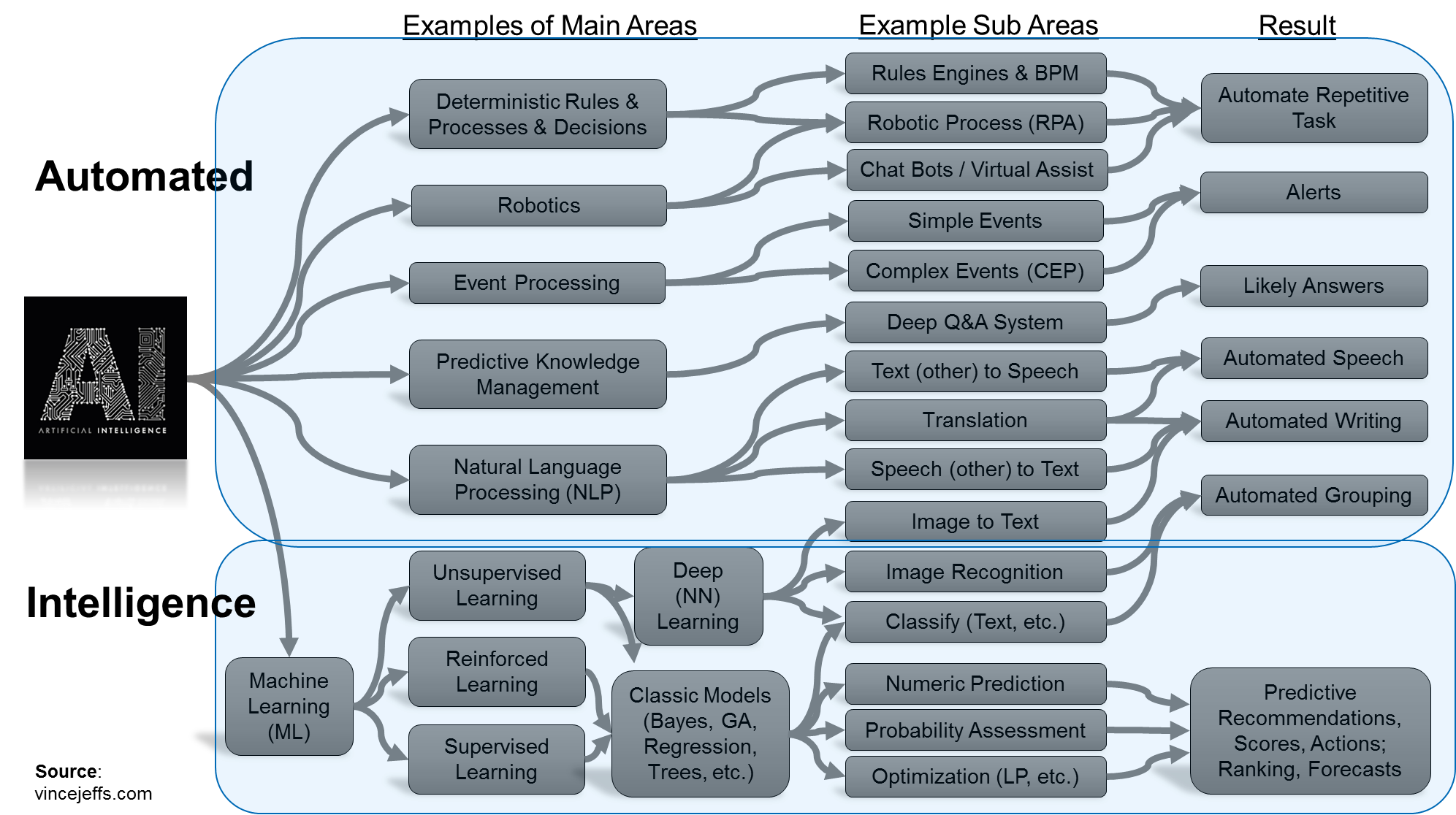
Regarding different sub-areas of Artificial Intelligence and its class of technologies, consider this organization:

(Note: these categories are not mutually exclusive in that a given application may benefit from one or more of these technologies)

  • Machine learning – Algorithms using statistical methods designed to predict or forecast something. The learning is either supervised (i.e., assisted) because we either know the outcome trying to be achieved (or we have a teacher to inform us) and can determine if the model is right or wrong – or unsupervised (i.e., unassisted) because we have no idea of the patterns or outcomes that may be best).  The system “learns” if over time its predictions and performance improve.
  • Text, Video, Audio, and Image Analytics – this code scans unstructured data, and finds entities/objects, and classifies them (and/or extracts them). Deep learning is an advanced form of image analytics – using a technique with layers of brain-like neurons (Recurrent Neural Networks (RNN) or Convolutional Neural Networks (CNN)).
  • Complex Event (Monitoring) Processing (CEP) – an engine fed streaming data from one or more source, which detects certain patterns and then initiates follow on actions or processes.
  • Deep Q&A – using an AI system that has access to previously compiled knowledge sources; it scans, filters, and presents the best likely answers to questions.
  • Natural Language Processing – this code translates spoken voice to text, or to some other form useful as input to another system. It can also do the reverse, translating some other system’s output to spoken voice.  It also can translate from one language into another, or just detect the language.
  • Natural Language Generation – this code takes input (images (still or moving), text, etc..), and generates text descriptions of what its seen or found.
  • Numeric Analytics – this code uses commonplace mathematics (simple formulas) to surface insights, focusing the receipting’s attention to aid their future decisions.
  • Robotic Process Automation – this code repeats tasks that it’s instructed to repeat.
  • Deterministic rules – if/then/else statements that don’t change unless a programmer changes the rule.

Click here for an AI diagram of how I’ve organized these into building blocks so you better understand where each belongs in terms of its contribution to automation or true machine intelligence

AI Automated Intelligence

CRM AI Vehicles –

Regarding implementing AI use cases in CRM for improving customer engagement (e.g., using any code and a combination of the above algorithms), consider these main vehicles:

  • Virtual Assistants – a module designed to aid and assist a human with decision making, problem resolution or task completion including:
    • Chatbots (such as Facebook Messenger)
    • Conversational interfaces (such as Alexa, Google Home)
    • Office assistants built into desktop software or mobile apps (e.g., automatically schedule meetings)
  • Digital Recommendation Engines – ranks and bundles content recommendations, product recommendations, offer recommendations, and service recommendations and uses containers/spots on web, mobile, agent desktops, email, kiosk, and other digital devices to serve these to:
    • An employee or agent to sell a product or solve a service case
    • Engage directly with a consumer through any digital device

CRM AI Use Case Categories –

bigdata_value2

Given these areas, there are hundreds of potential valuable AI use cases for CRM.  Here are some examples:

Marketing

Profiling and Tactic Execution:

  • Predicting missing or outdated customer data values

~Forecast data value using time series, or simple inflation adjustments
~Predict data value from an image

  • Segmentation, clustering, targeting
  • Next best product / service recommendation
  • Next best content recommendation
  • Next best promotional recommendation
  • Next best channel to engage on
  • Next best time to send
  • Next likely transaction (and timing of it)
  • Next best search keyword

Predicting Customer Behavior and Value:

  • Models to predict customer churn
  • Models to predict customer preferences (including a preference for a particular product/service)
  • Models to predict customer lifetime value
  • Models to predict current customer value
  • Models to predict customer wallet share
  • Models to predict customer re-activation

Dynamic Price Optimization

  • Optimize retail price of products/services
  • Optimize incentive levels (discounts) of products/services
  • Optimize price paid for ad buys

Marketing Operations / MRM / Marketing Planning:

  • Tagging/filtering content – Recognize an object in image or video
  • Tagging/filtering content – Match an audio track to known copyright material
  • Tagging/filtering content – Classify image content type
  • Content generation
  • View trending topics
  • Forecast market size, marketing revenue/costs
  • Budget allocation planning/media mix optimization

Influencer Marketing:

  • Content identification

Sales Automation

  • Next best lead
  • Next best sales activity
  • Next best sale rep
  • Sales contracts
  • Sales and demand forecasting
  • Competitive intelligence

Customer Service

Customer Service / Support

  • Next best service, support, training action to resolve a complaint/problem
  • Intelligent routing: Find the next best expert/agent to resolve a complaint/problem
  • Text and images uploaded to support resolving cases
  • Tag and classify support tickets
  • Support process automation
  • Estimating service volumes, wait times
  • Optimize scheduling and support resource utilization
  • Contact center volume forecasting
  • Estimate wait time
  • Optimize scheduling and support utilization optimization

Predicting Customer Service Behavior:

  • Models to predict levels of customer frustration or satisfaction
  • Sentiment analysis with all forms of data.
  • Reasons behind high churn likelihood
  • Models to predict intent (likelihood of a customer calling and why)
  • View trending support topics

Smarter CRM: Machine Learning Episode #2

You want Smarter CRM, don’t you?

In this “Mini-Cast” on machine learning (ML) and artificial intelligence (AI) for marketing & CRM, I outline the numerous applications you can use to improve customer experience.

AI for Smarter CRM
AI for Smarter CRM

In this second episode, I delve into the various areas of AI & ML applied to Marketing, Sales Automation, and Customer Service where ML & AI play huge roles in taking those functions to new levels of insight and intelligence, enhancing productivity, effectiveness, and delivering better customer engagement.

Episode #2 on YouTube:

Machine Learning Marketing Series – Episode #1

Introduction & History of Machine Learning:

In this inaugural episode, I explore some useful history on the various areas and aspects of machine learning and artificial intelligence, and its evolution leading up to today.

Specifically, I delve into unsupervised machine learning, deep learning, and software robotics as applied to customer relationship management.

Watch my  entire “Mini-Cast” series of short 5 to 10 minute videos on machine learning (ML) and artificial intelligence (AI) used in marketing & CRM to improve customer experience (CX).  The entire series is available from my website linked to my YouTube Channel:

Episode #1: Machine Learning Introduction & History (this one above)

Episode #2: Smarter CRM – Machine Learning Applications for Customer Experience

Episode #3: Marketing Timing & Content – 2 Cool Use Cases for Machine Learning

Episode #4: Marketing Results – Amazing Outcomes using Machine Learning

Episode #5: Marketing Learning Measurement & Monitoring

Episode #6: Major Players in the Machine Marketing Ecosystem

Episode #7: Adtech & Martech Machine Learning Convergence 

Episode #8: Machine Marketing – Hot Trends (coming soon)

Mind your P’s & Q’s for Balanced Marketing

Let’s not pretend the four P’s of marketing are dead, useless, or outdated.   They aren’t.  You still have to price your product or service and promote it in the right places.

These age-old marketing corner stones are as important today as they ever were to your operations.   What they don’t do, however, is provide you a compass to help guide strategy and insure your success.   For this, you need new age P’s and Q’s that will orient you, and serve to infuse both a predisposition toward “customer centricity,” and help you take pragmatic actions with customers for balanced marketing.

In truth, customer centricity is simple to achieve.  Give customer what they want.  What’s difficult is to do this and run a growing and profitable business.  To thrive in the digital age of the consumer you need a measured approach to a variety of factors.

Measure

So think about the below P’s & Q’s, and practice them to achieve balance when you plan and perform your marketing:

Four P’s

  1. Preference
  2. Personalization
  3. Performance
  4. Pervasive & Persuasive

Preference

Instead of centering your marketing on your products and simply spouting off about all its attributes, concentrate on understanding customer preferences first.   Regardless of your business, this is a better approach.  Sure, there are times when customers can’t easily articulate a need.  Consumers weren’t breaking down Apple’s doors demanding an iPod, yet they clearly wanted portable music.  So even in these cases, if you understand their behavior and fundamental need, you’re more likely to fit an offering to an expressed or latent requirement.

If you understand the market you are in, and what the customers really want in that market, and you hear them out, then you are on the right path.  If you can’t pinpoint them, and you rarely do research and gather data, you probably aren’t actually listening to your target audience.  Get to know your customers.  Listen to them.  Live in their shoes.  Learn from them.  When you do this, you will uncover huge opportunities to serve them better.

Interface with customers on many levels.  If you sell jets, listen to and understand more than just the airline buyer, but also the infrequent & frequent passengers, pilots, flight attendants, and maintenance crews.

Personalization

Make personalization self-service.   Figure out how to allow your customers to self select the marketing they receive.  Make it a dialog and give plenty of options.  Then, use that data to customize your marketing activities and the product and services you promote.  Often, the same offering will fit different customers, yet make it so because they selected it as opposed to they had no choice.

Performance

You can listen, and you can configure, but unless you can deliver, your marketing is the noise before your defeat.  Put time & effort working with your product teams, your operations, your fulfillment, your service staff, and your training folks.   Once you get a sale, make sure the customer is not subject to old school mentality where the post-sale devil appears and declares, “Oh all those promises were for when you were a prospect, now you are my customer.”

Pervasive

Get your message out – everywhere you can where your target audience is.   Nowadays, there is a lot of marketing clutter, and you are going to need to work hard to get reactions to your impressions.  You don’t always have to spend traditional marketing dollars or use classic methods to do this, because you can growth hack.  For example, consider using “Contextual Incremental Marketing” as a methodology to sustain your message in digestible chunks more likely to sink in over time.  Leverage your customers as a marketing channel – when they have success, they are your most credible spokespersons.   Spend a portion of your marketing efforts teasing out their accolades and distributing their stories.

In addition, leverage social influencers, blogs, crowd sourcing, partners, affiliates, analyst, review sites, and local community efforts to spread your word.  In other words, use the digital network effect to your advantage.

Digital-Marketing

Four Q’s

  1. Quality
  2. Qualification
  3. Quantification
  4. Quicker

Quality

A new adage I’ve heard that I totally disagree with is “Speed trumps Quality.”  It’s a sad commentary on society in general, but specifically for Marketing and Products, it’s a problematic long-term strategy.   You will erode your customer trust if you don’t have quality marketing, sales, and products.  Strive for high quality, and take the extra time to get it right – the alternative of sloppy or mistake-ridden output is unacceptable to your customers.   Find me a brand that has stood the test of time, and I will show you a brand with quality at its core.  So measure twice and cut once.

Qualification

Don’t be afraid to qualify with whom you do business.  You have a business to run, and if you did a strategic business plan (I hope you did – if not – go directly to jail and do it – do not pass Go – do not collect $200) – you have a specific market and customers you are focusing on.  If you stray outside that, using the same plan, it’s a recipe for failure.

Consider customers that aren’t properly qualified for your existing products as a potential future opportunity for another adjacent market with another product.   Then, study it and make a deliberate decision of whether to enter that market segment.

Quantification

If you aren’t measuring it, you aren’t managing it.  Moreover, if you aren’t managing it, you can’t improve it.  You need to commit to sustained measurements so that you can adjust dynamically.   Consider this – if a police officer pulls you over and asks you why you were doing 60 mph in a 35 zone, and your answer is that you didn’t think you were speeding because when you checked a week ago, you were going 35 mph – that argument won’t hold weight, and it doesn’t hold weight in your business.

Quicker

You need quality, but you also have to be quicker than you were before, and certainly faster than your competition.  This means speed in detecting changing market conditions and agility in adjusting your messages and product to that new dynamic.  You must be real-time in your ability to use customer context, and factor it into your decision-making, using a next best action approach.

5 tips to avoid becoming “A Distracted Marketer”

DistractedCustomer

In June of 2015, I wrote about the Distracted Consumer with their heads buried in smartphones and attention spans decreasing from 12 to 8 seconds in just 15 years. It occurred to me that marketers, subject to the same rush of options, information and environmental forces, are highly distracted also, and may not be focusing enough to get real value out of the solutions they buy and attempt to implement.

As a consultant for years, my DNA is wired to help solve problems and find ways for clients to streamline and improve their marketing efforts, ultimately improving customer experience for their clients.

Stick with me (proving you can outlast the attention span of a goldfish) as we explore 5 areas of distraction that can derail you from sustained improvement, and consider ways to combat those:

  1. The explosion of options and the sea of information regarding technologies & practical applications, much of it contradictory, hyped up, biased, and confusing, makes it difficult to find and focus on the right technology platform.
  2. The amount of data available can be overwhelming and lead you down countless dead ends. Big data, little data, slow data, fast data.  Its data galore and finding the right data and putting it to use in a timely fashion before it decays into worthless bits can be challenging, costly, and elusive.
  3. The disruptive organizational environment. Matrix management and average tenure in jobs less than 3 years means instability in teams, long term planning, and accountability.  Disruptive isn’t always an adjective to be proud of.
  4. The death of critical thinking trumped by speed over quality.
  5. Agile as a crutch to why people drop everything to work on the new thing when often the newest thing isn’t always the most important thing, or the thing leading to highest impact & value.

So many choices

TooManyChoices

Let’s face it.  It’s great to have choices.   It allows us to discriminate as consumers on features, quality and price, and push our suppliers to compete and innovate.   Marketing technology is certainly no exception.   Chiefmartec.com catalogs nearly 4000 companies supplying a variety of technology to the marketing function.   Yet picking solutions is very different than walking down a cereal aisle and deciding on your next breakfast.  More akin to a pharmacist that needs to understand the interactions when mixing medications, a marketer needs to understand how these technologies will (or won’t) interact to produce a productive overall solution.

Before you pick a technology stack, explore examples where other firms have successfully deployed a solution with various vendors “stacked” together.   Ask yourself if they received the value and within the budget and timing they expected.  Once you pick one, be patient (within reason) and give your user community a chance to adjust to it, and adopt its full potential before you jettison it for shiny new parts.   Find a core linchpin vendor, and build around that firm and its technology, making sure that company is stable, innovative, and invests reasonably in its products versus its exit strategy or next acquisition.

I’m drowning in a big data lake

Have you ever started searching the internet for something and 30 minutes later find yourself reading an article that has absolutely nothing to do with what your initial pursuit?   Sales & marketing data trails are no different.   With a remarkable amount of data, often linked together with drill downs, report hyperlinks, summary and details tabs – you can quickly get lost in a maze of data.

Marketers need new discipline and training to navigate data and discern bad data from good data.   Before embarking on data exploration, it helps to have a hypothesis in mind, and then set out on a path to prove or disprove it. Use caution and judgement to verify data resources, tossing out dubious sources.

Stick with some core tools that enable you to navigate, slice & dice, fuse, and distill data.  Learn some deep features and exercise your proficiently with them, just as you regularly exercise different muscles to stay in shape.   Spreadsheets, like tools in a plumber’s toolbox, haven’t changed that much in 20 years and in many cases work just fine.

Disruption corruption

These days, we’ve been disrupted by much more than travel and leisure start-ups.   The workplace culture is one that breeds and seems to reward attention deficit disorder and interruptions.   There is actually a premium put on impulsive behavior, hatched by a technology crazed society that fears they may become outdated and obsolete thinkers because they have been offline for more than 15 minutes.

Interruptions abound in our lives.  It’s what’s killing our attention span.  But to be a happy and productive marketer, you need to find your quite place and time.   I find it early in the morning.  My brain is fresh, my associative thinking runs freely, and I have some time to plan ahead and some control over the interruptions, which later in the day become harder to ignore.  I use this time to plot out longer term efforts, take stock in what I’ve accomplished and what’s in flight, and then factor that all together to adjust priorities in tune with my long term objectives.

Find your happy place and time, and use it to get deeper into a subject, a skill, or to perform some research that otherwise invariably falls victim to death by fragmentation.  Avoid forcing something out prematurely if it hasn’t been subject to testing or vetting commensurate with the expectations of its audience.  Use your practical judgement to tradeoff the benefits of a rush job with the consequences of shoddy work.  Justify the time needed to question, fact check and sustain deep analysis.  The world still needs a healthy dose of this from those willing to buck the new world disorder.

The need for speed – the death of the deliberator

I’m not suggesting speed is always bad.   If you can crank something out with “good enough” quality, and you beat your competition to market, you gain a first mover advantage.   That said, it’s easy to see the deterioration of product, service and content depth and quality, as massive quantities are pushed out at breakneck speeds by dubious producers and publishers – or simply regurgitated into the echo chamber of the digital world.

ContentClutter

Yes, it’s the golden age of the individual, where anyone gets a platform to be an author and self-proclaimed subject matter expert.  Yet alone, that doesn’t make the ideas worthwhile or the end product immune to scrutiny. Take the necessary time to question things, double check them, and dig deeper to find something unusual or interesting as you probe into that next layer of analysis that can lead to real insights.

Hand me my agile crutch please

Agility is critical during a performance, when things don’t go according to plan, or as a marketer when you are:

  • Responding to seismic market forces
  • Using it to quickly test and learn and refine new ideas.

Don’t let it, however, becomes a crutch for failing to plan, concentrate, and see tasks through.   Form a hypothesis or formulate a project plan, plot a path, and stick with it unless you encounter an actual example of a major market force that should be factored in.   I’m sorry, but these disruptions don’t happen every day, although rhetoric would suggest otherwise.

Agility works best when it’s backed up with a thoughtful game plan.  The game plan forms the blueprint and guardrails you operate within.  The tactics you employ to achieve your goals should be flexible as you tactically maneuver once the action begins.   If you alter your course in ways that have no connection to your overall strategic plan, the clamor from these random adjustments will be the noise prior to failure.

Instead, use the agile approach as a methodology to execute on a grand plan & mission – with the difference being that you are simply releasing, communicating, and adding value to your constituents on a more frequent basis during the full length of your overall master effort.

5 traits of Super Marketing & Content – All year round

superbowl

As a lifelong marketer, I love this time of year.  Super Bowl season is when everyone is talking about one of its main attractions – The Super Bowl Commercials and Content.   Which are the most creative, funny, and memorable?  Can you actually remember the brand that ran them?   Do you remember that ad from 20 years ago?

What dawned on me was this.  As marketers, if we could only harness this level of excitement, interest, engagement and positive reactions toward marketing and selling, year round, then we would have the right recipe for massive success.   But like the concept of Growth Hacking, we also need to find a way to harness key elements, but then execute without shelling out inordinate amounts of money.

If you have noticed, there has also been an expanding halo effect around game day commercials.   Supporting digital programs in the weeks leading up to the big day, social media contests, Top 10 greatest ad videos, and chatter for days afterwards.

So what makes Super Bowl advertising so compelling (besides the inordinate amounts of money shelled out)?   I think it boils down to these key things.

  • Great ads are extraordinarily funny, surprising – sometimes even a bit shocking – and certainly unique and innovative, in a way that relates to a wide audience.
  • They tease out emotions we can relate to (universal appeal), and are amplified in a way that we cheer.
  • Everyone gets to be a critic, in the moment, and our emersion in current events is often tested. So since we feel our opinion matters, we pay attention and weigh in.  In other words, we are engaged.
  • There is a sense of anticipation and a high bar. We have seen the stage and set before, yet the actors and props are unknown.   Nonetheless, we know those that take the stage have to be pretty good.
  • Products aren’t being sold by the company. Instead, it’s either an experience or feeling, or if it’s a product it’s being sold by a celebrity, an ordinary child, or even an animal.  All things we love and relate to more than companies and brands.

Easier said than done?  Not necessarily.  Although your budget, creative powers, and your casting may be more limited than Apple or Coke, you can still follow these rules of thumb, asking yourself this question each time you create content, “Is this going to capture the imagination of my audience, and build upon a great story and reputation.”

Take an example.   Suppose you are selling business software – conceivably not the most glamorous product in the world to try to sell.   Is your content creation approach really just like everyone else in your market?  Describe your features; show your return on investment, blah blah blah.   Is that catching and unique?   Will you pull some emotion out of me?   Will I champ at the bit to share my opinion with others?  Will I wait with bated breath for your next piece of content?

Rhetorical questions with obvious answers.   You need to take risks to win.  Yet you can do this in a way where the risks won’t really be that great, and the rewards are likely.   Stand out.  Use others to tell your stories, be funny and visually stimulating, and articulate the extraordinary experiences I will have when I sign up to take my journey with you.

Note:  These views are my own, and not that of my employer

Improve Customer Experience with 5 (Almost) No-Brainers

As a consumer, I’m often disappointed when companies don’t get the little things in Customer Experience (CX) right.  For example, I frequently stay at hotels, and I always ask for a room away from the elevators, but they never remember it, and I can’t note my preference.

customer experience duh

CX professionals and Marketers can benefit by reaching the first level of being “Customer Friendly”, and doing this with consistency and meaning.  Small things matter, such as knowing someone has children, what products they already own, and promoting what is relevant to them.

Sounds really simple?  Yet to do that – if you aren’t a small business – you need coordinated mechanisms to record customer preferences, common history, a standard set of rules, and then a way to surface key information and recommended actions to all customer facing staff and systems.  Functionally it’s not that intricate, still today many companies don’t do this well.

Why is that?  I think it’s because they aren’t seeing the cumulative value, and as such can’t envision or measure the overall benefits derived by connecting these dots.  Simple improvements to customer experience – applied one step at a time – build upon each other.

Everyone agrees that having institutional client memory (a 360 view) is valuable – and great entrepreneurs relish it, but large organizations struggle to build and provide it, for a variety of reasons. Constant acquisitions, distributed staff, legacy technologies, and silo systems – or worse, simply losing sight of customer centricity.  As the excuses build up, competitors swoop in with new technology and agility, and fill the customer experience vacuum.  Although these players may be disruptive, usually they aren’t employing earth shattering methods or technology.

As pressure builds, large entrenched players are forced to take stock.  They reflect on expensive efforts that didn’t meet ROI promises, such as failed Data Warehouse and CRM efforts, and it taints them with an overly jaded mindset.   If this describes your corporate culture, pull an alarm bell, ringing for an attitude adjustment.  The message is clear-cut.  We have to fix this – pronto, and it shouldn’t take millions and years.  Find the CX “No-Brainers” and execute on them.

computer86-brain

All the rage these days is about Personalization.  And personally, I love it.  And it’s so easy.  Just make sure to remember all the little things about customers, particularly the things they share, and make them feel special.   And that, my friends, in a nut shell, is Personalization.

Here are 5 examples of No-Brainers and likely outcomes.  Literally hundreds more can spring from these:

  • Getting little things like names right is really important. My name is Vince Jeffs – not Jeff Vincent (in fact, where I work at Pegasystems, there is a Jeff Vincent, and you can only imagine the fun that creates).  If you call me Jeff repeatedly, my sense is you don’t know me and don’t really care.  Record children and/or pet information also.  If they tell you something about them (like their names), record that.   Make sure you use it wisely, when it counts and with class.  If you do, it matters in a massive way.  For instance, if you sell Pet Supplies, you think this might be important?
  • Document product interest and purchase activity, whether based on search, surfing behavior, or traditional conversations and transactions. Incorporate that knowledge into your near term marketing efforts.  Customers will love when you send relevant offers.
  • A customer shares when it’s their birthday or anniversary. You remember it, and on that special day, wish them well.  I don’t think I’ve ever heard anyone complain about being wished a Happy Birthday.
  • Demonstrate you remember their business, and show appreciation for it. Keep RFM statistics (How Long/Recent, How Frequent, How Much), and use it astutely.  A staff member saying, “For 10 years we have had the pleasure of having you as a customer.  Thanks so much!”  Again, you think that might make a difference?
  • Remember something really unique about each customer, use it judiciously, and make them smile. Don’t try to infer this, by appending 3rd party data.   You aren’t clever trying to deduce I’m a cat lover because I subscribe to Modern Cat.   However, if I mention I love Blues Guitar, and you cater to that later by recommending shows in the area, there is no way that won’t tickle me, even if the shows aren’t that interesting.   At times, you will have no choice but to put prospective customers into segments, because you otherwise can’t reach that audience.  Yet once I’m a proclaimed customer, ditch the mass segmenting and assumptions, and go instead with my stated preferences.

Your goal is to do this at scale, while executing like the corner bakery.  There is no reason why you can’t put an initial Customer Decision Hub – An Always on Customer Brain into place in 90 to 180 days; regardless of the size of your firm. This is why I entitled this post “… (Almost) No-Brainers” because you need this brain, but what it initially thinks about isn’t that sophisticated.

customer decision hub

True, it will take time to connect to more data sources and customer channels, but in less than 6 months, your foundation will be in place.  In mega firms, there will be 100’s of people telling you it can’t be done.   In spite of this, I’ve seen it done.   Start with one or two channels, a single business purpose, and build decision strategies that are driven by a customer profile.   Assemble a library of actions associated with the business purpose.   Then rank these actions and execute on them.

And here is the really amazing thing.  Implementing subsequent no-brainers entails very little incremental cost.   I’m not a fan of fuzzy math, but this is a case where 1+1 does equal 3.

Note:  These views are my own, and not that of my employer

Top 10 Things for Marketers to Deliver on Great Customer Experience

bigdata_value2

A slight re-vamp of my last post taking out the holiday twist…

10.  Really get to know your customers. Make sure every customer facing person and system has access to your knowledge.

9.  When you have the privilege of interacting with your customers, listen to them (that’s context) and adjust your message, actions and offers accordingly. Provide them value, and get to the point fast.

8.  When they need help with their buying decisions, make it easy and convenient for them. Use your knowledge of them wisely (e.g., location, which buying stage they are in) and they will love you for it.

7.  Work closely with your product and engineers to ensure your product is indeed awesome. Bring them your innovative ideas and ideas from your customers.

6.  Tell them stories about your fantastic products, but more importantly have your best customers or someone they trust tell these stories.  That’s right – like it or not – they trust them more.

5.  Make sure you entertain them with these stories. Nothing is better than some humor and excitement to get attention.

4.  Treat each and every interaction with your customer as a “Moment of Truth.” It may be your best and it may be your last.

3.  When they get to the point where they are really interested, don’t sell to them – help them buy.

2.  Always respect them. Respect their privacy.  Listen to their concerns.  Try to understand their needs.

Microwave at 10 sec

1.  Evaluate every action you want to take as a marketer, and ask yourself one simple question. Will this improve Customer Experience?


Marketing Wish List – “All I want for the holidays”

In my series on Customer Data & Decisions, I’ve explored how marketers covet that prized asset a “360 Customer View.”  In this blog, I turn things around, viewing from the consumer’s eyes what’s expected from marketing today, in the form of a marketing wish list.

Marketing Wish List

The Final Countdown – A consumer’s holiday wish list for marketing

Hello Marketing, I’ve been thinking about my wish list for the holidays.   Like a kid in a candy shop, here it is:

  1. First and foremost, please make sure your company builds great product and services. I don’t care how well you wrap the present, or how much money you spend on the wrapping paper.  I care about the present inside, and whether it’s useful to me.
  2. Once you’re sure you have a great present inside, go ahead and tell me all about it. I don’t mind hearing your passionate stories about how great it is, if it’s really great.  But don’t take too long to do it because I’m busy and you won’t have my attention for long.  While you have my attention, feel free to entertain me.  I like that aspect of marketing.
  3. Oh, and by the way, before you decide on this great present for me, make a reasonable effort to figure out why I’m possibly interested in it. Once you do that, then and only then, direct your clever marketing at me.
  4. Maybe I don’t know I need your present. Fine, so tell me quickly and concisely why I need it, and what unique value it will bring to my life.
  5. When you decide to tell me you have a present for me, don’t expect me to work miracles finding out about it. Make a reasonable effort to figure out where I spend my time.  Marketing, I know you are like a modern Santa, with access to all kinds of big data on my every move that gives you real-time information on whether I’m sleeping or awake; my exact location at all times, etc. – so use it wisely.
  6. Take notice to when I pay attention to your marketing – what’s working for me and what isn’t, and learn from that. Like a comedian knows, timing is everything.  If I’m not clicking or I’m not laughing, then ditch the joke.
  7. FinalCountdownOnce you get my attention, treat that moment like we were potential friends meeting for the first time. If you’re interesting, friendly, and we have things in common, we will probably want to meet again.   So treat our relationship accordingly.   Make an effort to get to know me before you try to close me.   Marketing gets a bad name from “ABC – Always-Be-Closing” selling.
  8. Basically, don’t sell to me, help me buy. Point me to helpful information that demonstrates your present has value, will last, is fairly priced, and that others I’ll trust love it also.  If you are offering me something special, make sure there is a good reason for it being “special for me.”
  9. If I’ve told you or given you obvious clues that it’s not the “Greatest Gift Ever”, respect that. In other words, don’t sell beyond the “Really I’m Not Interested Now”. If I didn’t tell you why I’m not interested – you can ask me – but whatever answer I give honor it.  Don’t push any further.  After all, just as bad as me not taking your gift, is me accepting it and later telling others how useless it was and re-gifting it because I really didn’t like or need it.
  10. Microwave at 10 secAnd finally, Santa, can you please take 15 minutes or less and talk with that Gecko Company and ask them to spend – I don’t know maybe 15% less on mass advertising next year? I just can’t get that Song “The Final Countdown” out of my head.  On second thought, never mind, I know what they will say: “If you are a Mass Marketer, you spend big bucks to get inside heads….it’s what you do.”

For interesting further related reading, and reflection on the year 2015, read “The 2015 Marketing Wish List” at http://www.dmnews.com/marketing-strategy/the-2015-marketing-wish-list/article/387692/

Comments and alternative views are always welcomed.

Note:  These views are my own, and not that of my employer

The CSI Guy – Customer Success Investigator

sherlockRecently I read a fascinating article on how crime investigators are using machine learning to find patterns and uncover insights that otherwise wouldn’t be detectable.   Investigations ranged from criminal to cybersecurity, competitive counterintelligence, and corporate litigation.  In one example, a firm showcased how – if this technology had been available during the Enron era – they might have proactively detected the scandal, potentially averting the crisis.  Their demo traversed 500,000 Enron emails, and as it did it learned how to flag suspicious ones.

It’s not news that pattern detection software works for fraud detection.   For years, banks have employed systems that scan structured credit card transaction data, and flag unusual activity.  Yet what occurred to me is this same approach and its specific techniques are extremely well suited to the art and science of developing customer intelligence against unstructured big data.   Customer experience pros could then unlock new mysteries, and take appropriate actions leading to great customer success outcomes.

The first thing criminal investigators do is they gather all the facts they can, from any available source – Emails, phone records, texts, web activity.  The adage being “Leave no stone unturned.”   It’s never clear at the start of any investigation which clues might matter, and may link to others – so all are important regardless of their form.    As the investigation unfolds, machine learning techniques, such as neural networks that use self-organizing cluster maps (known as SOMs) can help find patterns, and eventually help the investigators form a hypothesis.  Available evidence is used to test whether the facts fit the theory.

Shifting the frame of reference, gaining customer intelligence and using it to solve for marketing and customer experience challenges can benefit from this same methodology and technology:

  • Consumers leave clues about their preferences and behavior in many places; sometimes in unstructured forums, like social media, product reviews, and blogs.
  • It’s virtually impossible to sift through this data without the aid of technology and automation.
  • Machine learning can be used to find patterns in customer activity, such as what product they are most interested in buying, or that their sentiment is trending toward total dissatisfaction.
  • Once patterns are detected, predictions can be made and actions triggered in efforts to anticipate needs or alleviate matters.

As a consumer, my natural reaction might be to say, “That’s creepy and spooky”.   Ironically though, most firms simply want to use this to improve your experience with their brands since they know it’s critical to their health.  Repeatedly, surveys show above price and product, people leave because of dissatisfaction with the way they are treated.

But the level of dissatisfaction is qualitative and differs by customer.  One customer who experiences a single network issue may become enraged, while another may be more tolerant.   Knowing this and the value of each customer helps the company treat each situation with a custom tailored response.

That all sounds like common sense and easy, right?  Try doing it on millions of customers, with billions of bytes of unstructured data in their direct conversations and behaviors, and their indirect musings on social media, in blogs, and elsewhere.   Moreover, try to learn when each customer reaches various stages of interest or displeasure, and overtime improve your ability to predict these and take timely action.

Since the dawn of time, we learned that to survive we needed help from machines.   Use this newest breed of machines along with time tested investigation techniques to crack the enigma of your customers, gauge their state of mind, and delight them with personalized experiences.

Note:  These views are my own, and not that of my employer

Incremental contextual marketing for the distracted consumer

Consumers today are distracted and so I’ve coined a new term describing how to reach them: incremental contextual marketing.   The idea came to me by when considering the mental diagnosis of ADHD, and then drawing parallels to phenomena observed in modern consumer behavior.  In this blog, I explore this and then unveil some thoughts on how to best approach it with marketing techniques.  And I’m going to try to do all that in a short blog, because…well…read on.

Blame it my ADHD

“I feel like I’m from a different planet.”  Years ago, this statement might have been uttered by a person diagnosed with ADHD – Attention-deficit/hyperactivity disorder.   Yet, it’s how I feel today when I compare myself to the average modern day consumer (is there such a thing?), with their impulse decision making, short attention span, and lack of focus.  Does everyone have ADHD?  Of course not – that’s a real mental disorder, and not one to poke fun at.  But call me crazy because when I consider an important purchase, investigate a brand, or generally try to write about something or solve a problem, I take a deliberate approach, use critical thinking skills, do in-depth research, triangulate sources, and plan ahead.  One thing is certain – I know I’m from a different era.

Brain with ADHD

Consider this definition of ADHD from the Mayo clinic website:

“ADHD is a chronic condition that includes a combination of problems, such as difficulty sustaining attention, hyperactivity and impulsive behavior.”[i]

Or this about those with ADHD by William Dodson, MD from ADDitudemag.com:

“The ADHD world is curvilinear. Past, present, and future are never separate and distinct. Everything is now. ADDers live in a permanent present and have a hard time learning from the past or looking into the future…”[ii]

Sound a little like today’s in the moment consumer with a gold fish like attention span, who expects instant gratification and exhibits spontaneous buying behavior?   It’s no secret; the world we live in promotes and fosters this behavior.

  • Consumers are generally impatient and hyperactive. They get upset if they are in any line or have to wait for anything for more than a few seconds.  They are upset if businesses don’t remember them.
  • Consumers can’t focus. They are constantly interrupted or busy with smartphones, multiple devices, packed schedules, and keeping connected with extensive networks.   The average user checks a phone 150 times per day[iii].
  • Consumers live in the moment. They quickly forget their own loyalty history (or lack thereof), and often inflate their true propensity to do something in the future.  They expect their present context to be understood, catered to, and appreciated.

Is there a cure?

Although you won’t change this conduct, you can still accomplish your goals by employing a best practice I’ll term incremental contextual marketing.   As a marketer, accept that there is very little patience, increasingly shorter message shelf lives, and a consumer that is less and less receptive to any outbound marketing, or any message for that matter that is too long or ordinary.   Make no mistake, you can still build brand awareness and garner loyalty – however realize two things:

  • It can take years to build and establish loyalty, yet with one bad experience it can evaporate in seconds, since a consumer’s mindset is, “What have you done for me lately?”
  • You need to message in waves; in small compelling quickly digestible chunks available in any channel.

On the second point, and this is key, even if you have a deeper, more complex, longer term idea that you need to explain or impression you want to make, break it up, and message it over a period of time.   Incremental contextual marketing means both repeating and/or building upon your message, always using current consumer context to reinforce, sustain, adjust, and evolve it, with the end result being a better educated consumer, more likely to remember and to be impressed.   This approach works for marketing a product, educating a consumer on your services, or surveying them for preferences.   The stream of tactics used can be repetitive or additive depending on the goal.

For example, if your primary goal is brand awareness, a repetitive message is fine, but don’t repeat it in the same slots, at the same times, using the same channels.  Mix those up.  Make your points proactively to consumers in their preferred outbound channels, with the same messages available to them when they are in-channel.

If your goal is educating the consumer on retirement strategies, run a series of messages that build on each other, with each subsequent message summarizing key points from the latter, and then appending new ideas.  Use current context to adjust the message, if for instance, the consumer has clearly become interested in college savings plans.  The trick is for each message to be randomly incremental (without a predictable rhythm but still a sustained undertaking) and conversational – strategically placed in varying media at a calculated (but somewhat random) cadence so as to optimize its movement from short-term to long-term memory.  Use storytelling and make it relatable in its tone.   I learned the effectiveness of this method a few years back when I embarked on learning French as an adult – That said, I think you can be much more effective that I was in becoming fluent by not waiting too long before you start.

As a firm, you need an approach, a systemic mindset, and technology stack that can react and adapt to this dynamic environment.  Ironically, some of the same technologies that may be reinforcing this behavior can be used to combat it.  Together, the total solution has to be customer focused, concise, real-time (responding in milliseconds since the consumer won’t wait), consistent, contextual, and unified.  It must be unwavering in its ability to identify consumers with pinpoint accuracy, summon a photographic memory of their interests and preferences, factor in their current context and condition, and then act with predictive intelligence, rendering easily consumed yet compelling content, all while still delivering actions with a personalized / human touch.

We live in a fast paced, short story world, with millions of micro blogs (less than 500 words), billions of videos (less than 3 minutes), and trillions of twitter posts (less than 141 characters).  Accept what you can’t change and use the right methods with the time crunched consumer, craftily using bits of incremental air time to make your points.

You made it to the end (a blog with nearly 1000 words…congratulations) and so perhaps you are like me.  For the rest from earth, however, I’ll need more posts.

Comments and alternative views are always welcomed.

[i] http://www.mayoclinic.org/diseases-conditions/adhd/basics/definition/con-20023647

[ii] Dodson, William.  http://www.additudemag.com/adhd/article/10497.html

[iii] Meeker, Mary and Wu, Liang.  Internet Trends D11 Conference.  Kleiner Perkins Caufield Byers (2013): 52