Professionals discuss marketing solutions involving robots at a tech forum
Today’s marketing strategies require both traditional marketing directly to humans and B2R Marketing – marketing to robots such as AI algorithms, search crawlers, and LLM-based assistants. B2R marketing requires optimizing for visibility, data retrieval, and pattern recognition. In contrast, marketing to humans requires appealing to emotion, trust, and value.
Successful strategies bridge both by using tech for efficiency while maintaining a distinct human touch. When marketing to robots, you aren’t trying to persuade a person; you are feeding data to a machine so it can confidently recommend your product in turn to a human. For this, you need to optimize for Entities & Context: Search engines and AI models map entities (people, places, concepts) rather than just keywords.
B2R Marketing:
Build topical authority by thoroughly covering a subject across multiple pieces of content (blogs, FAQs, social media).
Leverage structured data: Use clear, semantic HTML and schema markup to tell machine crawlers exactly what your business offers, your pricing, location, and operating hours.
Focus on the Answer Engine. Prep: AI tools like ChatGPT or Google Gemini synthesize content from across the web. Ensure your core messaging is clear, concise, and easy to quote, so LLMs pick your brand as a trusted source.
Zero-shot Prompting: Ensure reviews, product specs, and core value propositions are explicitly clear on your platforms so AI tools can effortlessly parse them when asked, “What are the best [your product/service] near me?”
B2H Marketing – Business to Human as we already know is different. Humans don’t just buy based on algorithms; they buy based on feelings, convenience, and perceived value. For this use:
Emotion & Storytelling: AI can generate text, but it cannot authentically inspire, make a consumer laugh, or demonstrate genuine empathy. Use storytelling, relatable customer testimonials, and a strong brand voice to forge emotional connections.
Complex Decision Making: While AI can handle mundane or transactional purchases (like reordering a staple product), high-ticket or emotionally driven purchases require a personal touch. Lean on humans for sales negotiations, crisis management, and complex customer support.
Original Thought: Humans seek true expertise and thought leadership. Invest in original case studies, data-backed white papers, and expert analysis that algorithms inherently lack the ability to create from scratch.
Find the Balance: Use a Hybrid Approach.
The most effective marketing strategies don’t choose between humans and robots; they use both to create a high-tech, high-touch ecosystem. Let AI and automated bots handle the heavy lifting of data analysis, lead scoring, and answering basic FAQs at scale. Reserve your human capital for building authentic B2B rapport, closing nuanced deals, and providing deep, personalized value that algorithms cannot replicate.
He woke up free. Not “I-have-Saturday-to-clean-the-garage” free, but “the-warden-forgot-to-lock-the-gate” free. To be perfectly honest, he wasn’t totally free, but more like 80% free. He had agreed to work on Wednesdays for a few months, so in effect his week would now look like this: Saturday, Saturday, Sunday, Thank-God-It’s-Wednesday, Saturday, Saturday, Saturday.
That Tuesday (or should we say—pseudo Sunday) didn’t start with fireworks. No champagne corks popped, no one handed him a mug, and there was definitely no huge party planned—though that last one surprised him since he spent a 40-year career in marketing, where parties were thrown for things like “This month’s winner for best LinkedIn profile.” No, it was just another Tuesday. Maybe life’s most profound events actually happen on Tuesday— like his dad’s birthday and Taco Tuesday.
Forty years. That’s roughly 10,000 business meetings, 2,000 stale conference room muffins, and about a million awkward elevator silences where everyone stared at the floor numbers like they contained the secrets of the universe. He’d been a loyal subject of the calendar, a devoted disciple of Outlook reminders, a high priest of the quarterly business review. And now, that machine had simply… stopped humming.
He felt like an ember—not the romantic, glowing kind from a campfire where people tell stories and make s’mores, but more like the industrial variety, drifting away from a coal-burning furnace.
Cast into the suburban breeze, he floated aimlessly. Not literally—that would require skills he’d never developed, like levitation or the ability to keep a succulent alive for more than three weeks. But metaphorically floating, guided by forces he couldn’t quite identify. Maybe the wind. Maybe curiosity. Maybe that random force that causes one to walk by the fish tank and realize the reason they’re so happy to see you is because they haven’t been fed in three days.
The blast-furnace had been his career inside the corporate world, a roaring inferno of spreadsheets, performance reviews, and the constant, low-grade anxiety of a thousand corporate thoughts, such as still trying to figure out 30 years later who had stolen his good stapler.
As a teenager—fresh-faced and armed with the kind of optimism that can only come from never having attended an all-hands meeting—he’d been lured in by the siren song of a steady paycheck and something called a “401k,” which sounded vaguely like a robot but turned out to be far less interesting.
He’d bought in. Done the things. Ticked off boxes with the grim determination of a man assembling IKEA furniture without the Allen wrench, knowing full well that something was going to end up crooked but pressing on anyway because the alternative was admitting defeat to Swedish engineering.
But today, the fire was out, and he was but an ember. He wandered through his house like a man who’d misplaced his purpose somewhere between the kitchen and his home office. The coffee tasted the same, but the silence was different—louder somehow, filled with the absence of things that no longer demanded his attention. No one needed a decision by EOD. No one was circling back or saying, “Let’s take that offline.” His inbox sat empty, probably wondering if it had done something wrong.
“Perhaps nothing was created or destroyed today,” he thought. His high school physics teacher would have been proud.
He stood at the home office window, staring out at a world that seemed oddly familiar, like a movie he’d seen once but couldn’t quite remember the ending to. This was it. The first day of the rest of his life. And it felt weirdly like childhood. Like summer vacation. Like that moment when the school bell rang and you sprinted out, not because you had somewhere to go, but because you didn’t have to stay.
He remembered being a kid in the sixties, when summers lasted forever and life’s biggest decisions were ones like whether to have Lucky Charms or Frosted Flakes—his choice was always Frosted Flakes because—well—”They’re GR-R-REAT.” Those were choices that seemed monumentally important at the time and probably were, in their own way. That world had no Outlook calendars, no performance reviews, no existential dread about quarterly targets. Just the pure, unfiltered now.
Animals had it figured out. Not the ones in business attire—though some of his former colleagues came close—but the real ones. When a gazelle is thirsty, it drinks. When it’s hungry, it eats. When it’s chased by a lion—well—it runs like hell. Simple. No monthly check-ins required. No one asking the gazelle to “circle back” on its calorie consumption metrics.
He liked that feeling.
Gawking out the window, he felt this gentle slap from the universe—not painful, just surprisingly clarifying. A thought so clear it could have been an interstitial pop-up ad, but one that he didn’t immediately dismiss.
For years, retirement had bounced around his mind like a ping-pong ball in a lottery machine operated by someone with a caffeine addiction. Half fantasy, half existential terror. He’d always envisioned it as a finish line—which was problematic since he’d never been much of a runner, more of a jogger type who stops to examine interesting plants—all which turn out to be weeds.
The concept had morphed into something resembling surrender, like waving a white flag. A “no más” moment, like when a boxer realizes he’d rather be doing literally anything else, including tax preparation.
But this particular morning—bathed in the kind of pre-dawn clarity that usually only comes after consuming questionable amounts of coffee—he saw it differently. This wasn’t surrender. This wasn’t a finish line. That morning, something shifted. He didn’t see it as an ending anymore. He saw it as a reboot. Not a fade to black, but a hard reset. Him 2.0. Now with fewer meetings and more meaning.
The goal wasn’t to stop. It was to start. To start asking different questions. Like: What do I want to learn? Who do I want to become? And how many days in a row can I wear sweatpants before my wife stages an intervention? In a sense, instead of a finish line, it was more like a pit stop. Except instead of someone changing his tires and handing him a bottle of Gatorade, he was changing his entire life and handing himself a chance to figure out what came next. Funny that for years he had searched for the meaning of transformation, but always in a business sense. Yet this was an opportunity for a fundamentally profound transformation. Like when a caterpillar becomes a butterfly.
The irony was delicious: after decades of having every minute scheduled, blocked, and optimized—now his new purpose was to discover a purpose. His first assignment in retirement was to figure out what his assignments should be.
Making peace with the past required what Marie Kondo would call “letting go” and what he called “admitting that keeping every National Geographic since 1987 was perhaps excessive and possibly a sign of deeper issues.” The past wasn’t right or wrong—it had simply happened, like most things in life, including his brief but memorable phase during a Movember when trying to grow a mustache that made him look like a disappointed walrus giving up on life.
The past was a movie that had rolled its credits. Looking back to critique it seemed meaningless, except to pluck a few lessons that might guide what he’d started calling the new movie of his life: “The Sequel: Hopefully Better Than Jaws 2, But Let’s Keep Our Expectations Realistic.”
“So, what are you going to do now?”
When he got the inevitable question, he wanted a good answer. One that might garner a response like, “Have you renewed all your prescriptions lately?” So how about this, he thought:
Soar. Then float a bit.
Not literally—again, he’d never mastered that particular skill, despite a high school guidance counselor optimistically suggesting “reach for the stars,” which in retrospect was questionable career advice. No, he would metaphorically soar, like an eagle. Or at least like a reasonably competent pigeon with decent navigation skills and a healthy respect for window glass.
To soar in an oxygen-rich atmosphere. To gape at sunsets, and at children’s artwork—which defied both physics and artistic convention and magnified the magnificent absurdity of existence itself. To be stimulated by genuine smiles instead of forced networking grins, by the quiet satisfaction of giving instead of the constant anxiety of getting, by the radical act of just being instead of the exhausting performance of doing.
He could travel the world. He could write a novel. Or he could just sit on the couch and binge-watch Netflix, which had its own dignity and required no special training.
The new life would have stress—but good stress. The kind that comes from another futile attempt at learning French —the practical application of which remained unclear — especially to those who had already expressed concerns about his mental state. Stress that pumps meaning into your being instead of slowly draining your will to live through meetings that could have been one email, or reading long email chains that should have been one meeting.
He would start small. He would volunteer at the local shelter, where maybe he’d encounter the unconditional love of a scruffy terrier-like mix named Sparky, which would prove to be surprisingly therapeutic. Did we mention what kind of shelter this would be? Anyway, the shelter inhabitants, he would soon discover, were excellent listeners and would never ask him to prepare a PowerPoint presentation.
Maybe he’d take a pottery class, using his clumsy hands slowly learning to coax something resembling self-defined beauty from lumps of clay. The misshapen bowls and lopsided mugs would be testament to his beginner status, but they would be his creations, imbued with his tangible effort and his newfound willingness to be bad at something without immediately giving up.
Maybe he would try creative writing, in complete contrast to the dry, corporate blogs he’d churned out for decades. Stories about his childhood, about his dreams, about the absurdity of modern life or the very real possibility that the “so-called lost office stapler” was more intelligent than he suspected.
Working and exerting effort, yes, but followed by that deep, satisfying exhale that expels any remaining toxins and lingering anxiety—like that anxiety he got every January worrying about whether he’d completed the Workforce Harassment training in time before IT made good on its pestering threat to shut off all access for non-compliance. The breath that comes after accomplishing something that actually matters, even if that something is just making his wife laugh or finally upgrading his old home appliances, so when he lost power he didn’t waste 10 minutes re-setting 10 blinking clocks.
This was freedom. Not the kind that requires a passport, but the kind that comes from realizing that the fire had ended, the smoke had cleared, and somewhere in the ashes was the possibility of becoming exactly who he was supposed to be all along.
The possibilities stretched out before him like an endless summer afternoon, full of potential and surprisingly free of 1 on 1 meetings. He was no longer an ember drifting aimlessly. He was a blowing seed about to land in fertile ground, ready to discover what he might grow up to be.
And for the first time in 40 years, he was genuinely curious to find out.
The end. Or perhaps, more accurately, the beginning.
It’s a Data Collector & Cruncher, Insights Producer, Real-Time Processer, and Channel Connector – But wait! There’s more!
Since the Dawn of Martech Times – The Goals & Principles Remain the Same
For a lifetime (mine anyways) marketers have sought the holy grail of one-to-one customer engagement: Right Customer, Right Time, Right Message/Offer, Right Channel/Place.
In pursuing that goal, those working for enterprises knew to scale beyond mom/pop audience size they needed big tech help – big data & insights about their customers, at-scale machine learning to calculate what to say and offer, a large & dynamic curated library of messages, as well as direct connections to the ever-growing channels to deliver them – both ones where customers were in channel (inbound) and ones where nudging was required (outbound).
Bringing at-scale tech to this goal started by using big databases. Those databases held customer account and transaction data and used queries achieving the first step – finding sets of customers with differences in customer behavior. And those differences proved to be great insights to train models and predict future behavior. Next, the pioneers matched messages to the predicted behavior segments. A likely buyer of a certain product just needed an offer for that product. Then, send that message, get a response, and chalk up higher conversion rates.
Take, for example, credit card marketers. They segmented their base into 2 main categories: Transactors and Revolvers. Transactors paid off their bill. Revolvers didn’t. So based on this, they offered transactors incentives to transact more so they would increase revenue (from fees charged to the merchants) and offered revolvers more credit – balance transfers / credit limit increases (where they made fees on the growing balances). The results: higher response rates, campaign lift (over controls) and more revenue.
That’s it. For the next 30 years, businesspeople in a variety of industries – from banking to telco to insurance and others – built out these systems and simply sought more data, improved prediction models, and connected their offers to more channels. Sounds simple right? Oh, but it’s not.
Why? Because big data got bigger, messier, and harder (and more important) to carefully manage. Getting the right insights from that data was (and still is) tricky. Establishing data lineage, privacy, and proper governance became crucial. Algorithms to accurately predict intent, and the right action to take next, evolved – and required controls. New AI methods sprung up along the way (and continue to do so – with GenAI another example – we’ll get to that later). And we all know about the proliferation of channels and digital devices.
Martech Stack Ecosystem – Then and Now
Ecosystem wise, not much has changed in the basic framework of a Martech stack since the early 90’s. Figure 1 shows the main components. Data is collected from a variety of sources at different velocities. Some data is distilled before it’s sent, providing insights. The stack itself produces both data & insights, and those are made available to other systems. A plan programs the content, data, and strategies employed by the decision system, and gets informed by the results. AI, both inside and outside the stack, powers predictions. Finally, ranked recommendations and messages are activated, and married (using metadata) with the appropriate content and delivered to channels. There, an orchestration layer may dip down to get actual content (e.g., digital images), and then consumers get the output (and hopefully react positively). Dashboards, reports, and analysis tools help marketers understand the results.
And the goals remain unchanged. Provide personalized experiences. Doing so generates lift (higher response and conversion rates) because more relevant offers are presented to customers who are more likely to want them. It’s not rocket science it’s just marketing science.
Figure 1: Conceptual Martech Stack and Surrounding Ecosystem
At the high-level, yup that’s pretty much it. I’ve researched and witnessed this pattern for 30 years. Attending conferences, following Martech Stackie Awards (2015, 2016, 2017, 2018, 2019, 2020, 2021, 2022, 2023.), reading countless analyst blogs, and working with hundreds of enterprise clients across the globe.
The 10 Immutable Laws of Martech Stacks
So, what have we learned? Since there is an overabundance of data, and technologies of various kinds come & go, lock in on designing the modern Martech stack so that it adheres to principles that have withstood the test of time.
Collect the right data. You don’t need a huge number of customer behavior attributes, but instead the right ones for the business problems being solved (e.g., reduce churn) and so reflect customer intent and cause and effect with likelihood to respond to offers to solve those issues.
Make sure collected data is accurate and, in as much as possible, feed it into your Martech stack in real-time.
Use segments to study common traits and behaviors. Assign segment attributes to customers, not the other way around.
Make decisions on individuals, not on segments.
Use adaptive models to calculate “offer propensity.” Establish that these models are learning continuously on data you are collecting.
Use one set of engagement strategies and rules for inbound & outbound decisions. Do not separate this logic and place it into channel systems.
When making inbound decisions, send them immediately. Do not cache decisions into channels waiting for a customer to appear.
With outbound marketing, only send permission-based relevant messages to customers on channels they opt-in and respond to, at times they prefer, and with content that is relevant.
Use behavior triggers, not pre-set schedules, to determine the right time to send.
Select the latest content just prior to presenting offers (e.g., versions of your offer, that include creative and language variation tests).
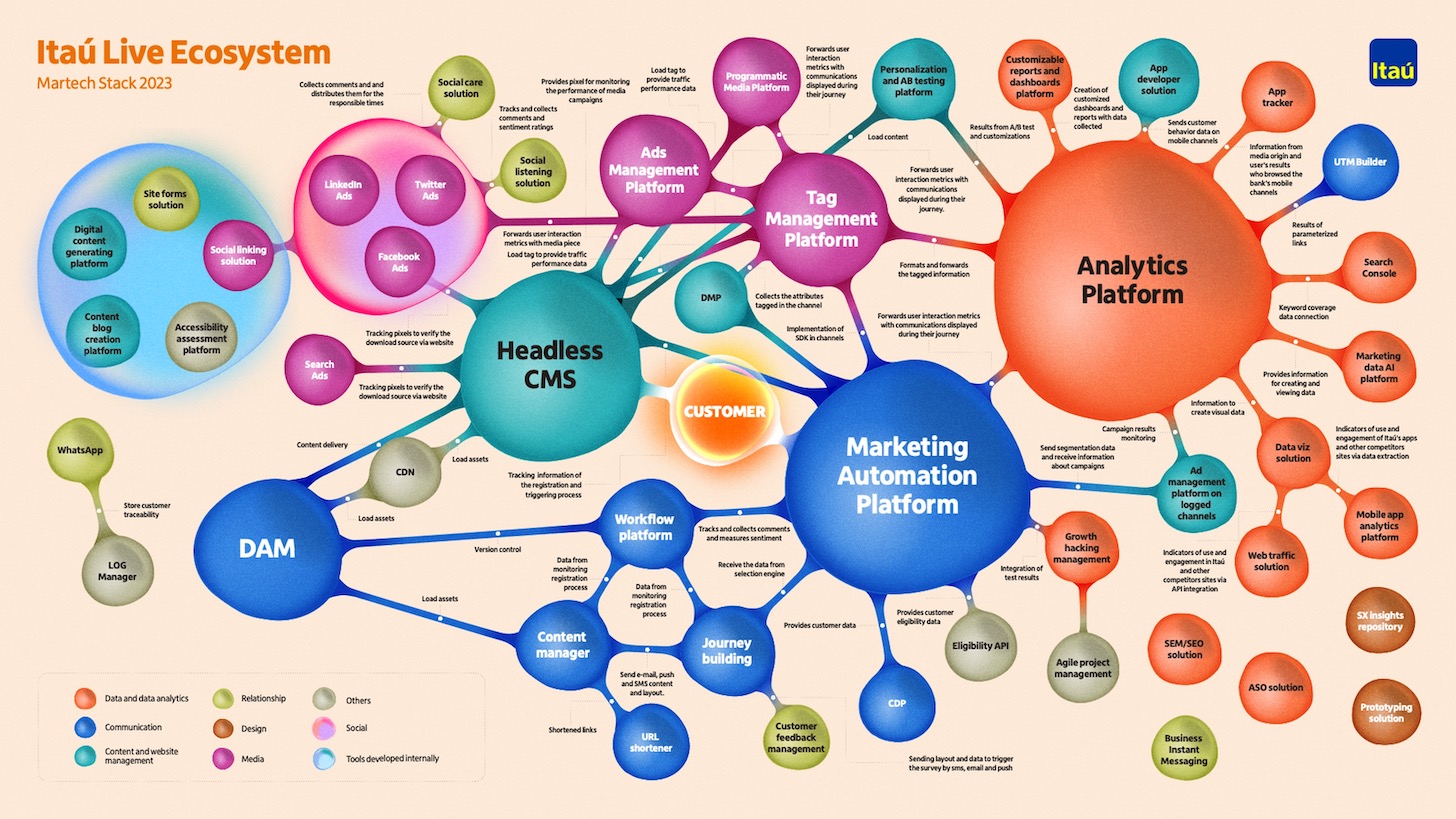
Compare your design to others that have been successful. Here is a 2023 stackie winner. Notice the biggest bubbles: Content, Execution Platform, Analytics (Insights).
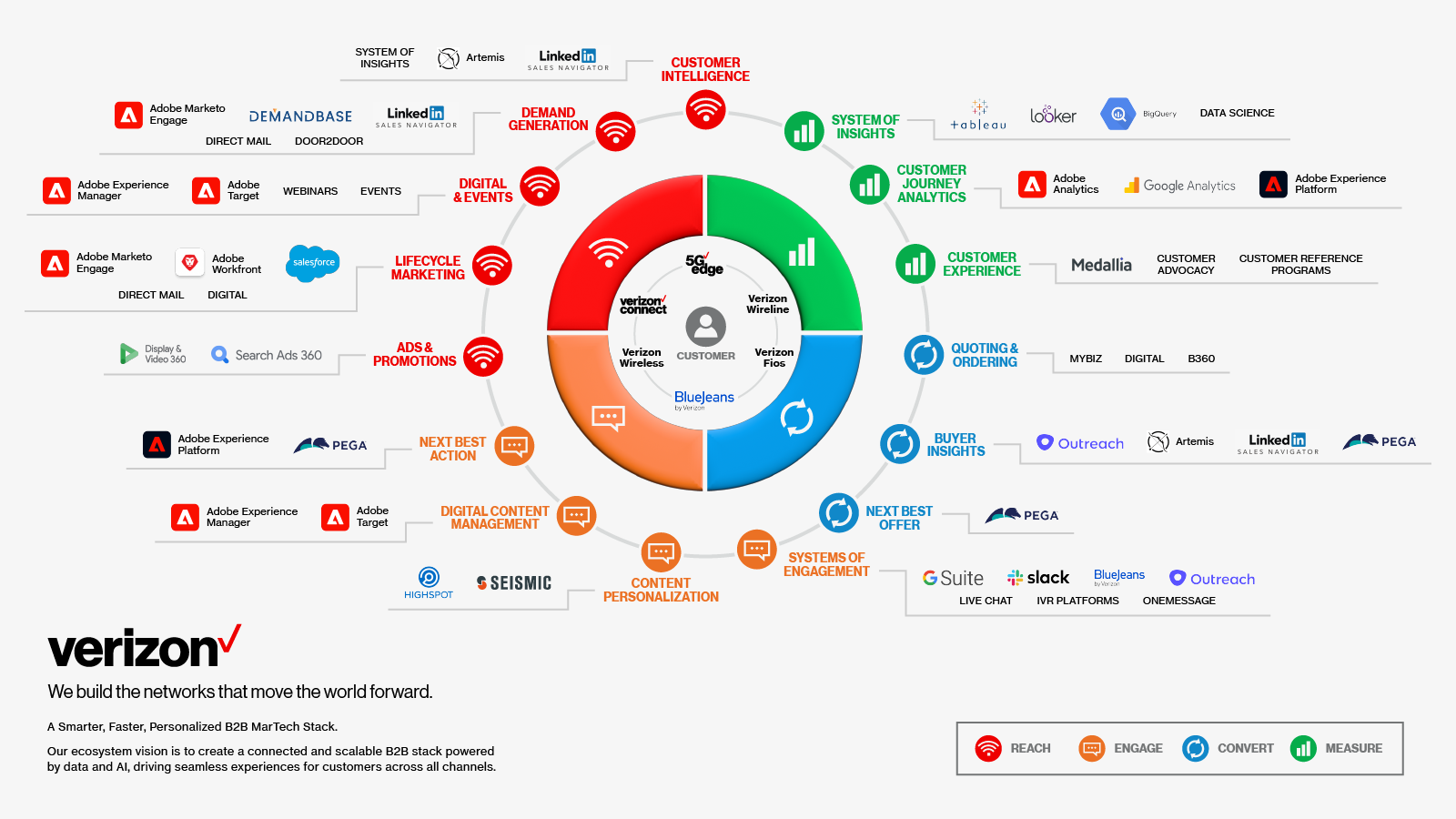
And here is another, centered on using data & AI to power a brain to make decisions during the customer journey cycle (awareness, consideration, decision)
Don’t drop what you are doing to chase the latest fad. In other words, don’t fall victim again to the “shiny new object syndrome.[i] ” Stay the course and be sure to devote some of your tech budget to innovation testing (maybe 10%). Hopefully, you were already doing that prior to the GenAI hype setting in.
Speaking of GenAI, test it to see if it helps with Law #5 (finding features for models to learn on) and Law #10 (challenger tests for creative & language variations)
Old saying but it holds true: You can’t manage what you can’t measure. Measure your program effectiveness by looking at champion creative, promotions, and messaging, and then try new variations, and measure again.
Conclusion
The evolution of the Martech stack over the years has brought about significant advancements in data collection, insights generation, interoperability, and customer engagement. The fundamental goals and principles of delivering personalized experiences to customers remain unchanged. However, as technology and data have become more complex, it is essential to adhere to the 10 immutable laws of Martech to provide the right ingredients for success.
Collecting the right data and ensuring its accuracy in real-time is essential. Segment customers to understand behaviors but make decisions at the individual level in real-time. Use adaptive models that continuously learn from data and help calculate offer propensity accurately. Inbound and outbound decisions should follow unified strategies and use behavior triggers for timely engagement. Outbound marketing should focus on sending relevant messages on preferred channels.
Build a Martech stack with a few foundational software products that provide insights, content management, and decision management. The emergence of GenAI offers opportunities to enhance model learning and conduct challenger tests for creative and language variations. However, it is important to test and measure its effectiveness before fully adopting it into the Martech stack.
Finally, measure program effectiveness and iterate with new variations for continuous improvement. By following these principles, businesses can achieve personalized customer engagement and drive higher response and conversion rates.